Showing posts with label visually impaired. Show all posts

Saturday, May 23, 2009

Real Cyborgs

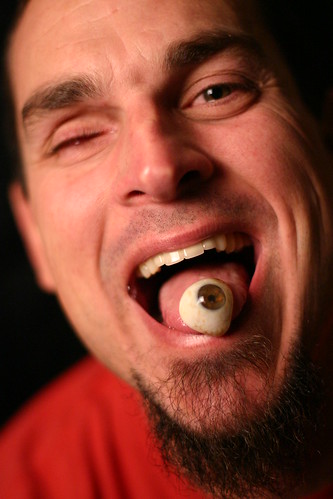
man with tongue sticking out and prosthetic eye on his tongue
Interesting article from Techradar.com "Meet the real-life human cyborgs" about individuals who are incorporating technology into their bodies. The most interesting part of the article deals with a film maker who had a camera embedded into his prosthetic eye. It goes on to talk about the research being done to use similar technology to assist individuals who are blind or visually impaired see. It also talks about an individual who has a usb drive built into their finger and use of other robotic prosthetics (see video below).


"Rob Spence is making a point, too. As the Toronto film maker explains: "I am a filmmaker who lost an eye so naturally I decided to modify my prosthetic eye into a video camera. I am not a lifecaster. I will use the eye-cam the same way I use a video camera now - or the same way any filmmaker would use a camera enabled cell phone."
Spence is working on a documentary "about how video and humanity intersect, especially with regards to surveillance."
Rob Spence's eye uses a camera sensor developed by OmniVision, which specialises in high quality cameras for medical devices such as endoscopes. The firm is also working closely with Stanford University's Daniel Palanker on the Retinal Prosthesis project, a hugely complex and ambitious attempt to use sub-retinal implants to restore blind people's sight.
As an OmniVision spokesperson told us, the firm "agreed to participate in the project to jump-start and/or fuel research to provide vision for the blind."
Palanker has published a number of scientific papers detailing the project, and they make fascinating reading. In Design of a high-resolution optoelectronic retinal prosthesis [PDF] he explains how "an image from a video camera is projected by a goggle-mounted collimated infrared LED-LCD display onto the retina, activating an array of powered photodiodes in the retinal implant." Essentially the digital eye enables the blind to see again."

Full Article


Image courtesy of gainesvegas


Thanks for supporting Maine VRC.

Wednesday, March 11, 2009

Maine Antique Digest on Assistive Technology

I never suspected Maine Antique Digest to get into Assistive Technology, but there it is. In their March 2009 edition, in their computer column is an article entitled, Assitive Technology
Geared towards antique users, not those collecting antique AT, it's not the most detailed article, it does introduce the idea those unfamiliar with what AT is. It covers vision, mobility and speech impairments. I would have liked to see a bit more detailed information, but it's a start.

"Many antiquers depend on their computers for things such as writing letters and using the Internet for research, buying, or selling, but suppose reduced vision or mobility interferes with using a computer. Such problems can arise suddenly because of injury or illness, develop gradually, or exist lifelong. Perhaps the following ideas will help you or allow you to help someone else.

Information on computer technology to overcome reduced vision or mobility is available. In fact, there is so much information that it is hard to sort out. We can only do a broad survey and point out possible directions. The Internet is a rich source, but every hardware or software solution found should be evaluated. Some will be obsolete or unsuccessful. Others still will be under development. The successful current products will vary greatly in price."
-Maine Antique Digest


Thanks for supporting Maine VRC.

Tuesday, December 2, 2008

Skype Boating


Interesting article from IT Director.com about using VOIP (voice over internet protocol) to help people with visual impairments navigate using a boat or participate in other sports.

"Ed Gallagher has slowly lost his sight over the last ten years. He was a keen sailor in the San Francisco Bay area and wanted to continue his hobby. He joined the Bay Area Association of Disabled Sailors (BAADS) but really wanted to continue solo sailing. He put together a solution using a head-mounted video camera and a video Skype link to a friend on terra firma. The friend can now see the boat and where it is going and direct Ed so that he can sail solo in the Bay."

Great example of using existing technology to meet needs, and how assistive technology needs to be neither expensive or specialized.


Thanks for supporting Maine VRC.


Boating photo used with permission from Flickr user tiarescott under Creative Commons License

Wednesday, October 22, 2008

Blind Leading the Non-Blind; Dialogue in the Dark


More than disability awareness, Dialogue in the Dark appears to give sighted people the experience of some of the more unique aspects of being visually impaired.
"Spend one hour in complete darkness, maneuvering through city streets and markets, relying only on a walking cane and a guide who is visually impaired. That's the premise behind Dialog in the Dark, a sensory exhibit that made its U.S. debut in late August in Atlanta...Dialog in the Dark, founded 20 years ago in Germany, opened at the Atlantic Station Exhibition Center on Aug. 30. It requires visitors to navigate through five familiar environments. They must complete routine tasks, such as selecting a pineapple at the market or purchasing a soda at a café, relying only on scents, sounds, temperatures and textures.

The first gallery visitors explore is a park — complete with a waterfall, creek and ground that turns from gravel to wood chips."


Thanks for supporting Maine VRC.