Showing posts with label Assistive Technology. Show all posts

Tuesday, May 12, 2009

JAWS Rap- Web Accessibility Theme Song

I never thought I'd see a theme song about web accessiblilty, but here you go. The Web Accessibility WCAG Theme Song.
My favorite is the speed rap at 1:15 and how his blind friends can understand him.


Song by David McDonald from ERamp.com


Thanks for supporting Maine VRC.

Monday, April 13, 2009

Braille Literacy less than 10%

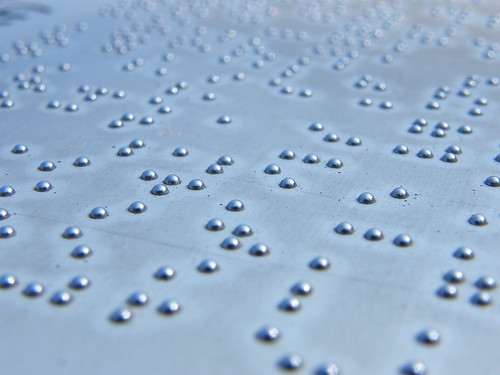
Close up of Braille letters on metal surface
USA Today reports that less than 10% of individuals who are blind are able to read Braille (while Disability Scoop takes a more inflamatory approach with "Vast Majority of Blind are Illiterate".

"Fewer than 10% of the 1.3 million legally blind people in the United States read Braille, and just 10% of blind children are learning it, according to a report to be released Thursday by the National Federation of the Blind...Instead, teachers ask students to rely on audio texts, voice-recognition software or other technology. And teachers who know Braille often must shuttle between schools, resulting in haphazard instruction, the report says. Using technology as a substitute for Braille leaves blind people illiterate, the federation said, citing studies that show blind people who know Braille are more likely to earn advanced degrees, find good jobs and live independently...One study found that 44% of participants who grew up reading Braille were unemployed, compared with 77% for those who relied on print. Overall, blind adults face 70% unemployment."- USA Today

Strong words and strong stats, but I'm not convinced. I have concerns calling individuals who can't read Braille "illiterate". Though I suppose technically accurate to some degree, it doesn't tell the story of individuals who may be "illiterate" but who have completed college degrees through the use of assistive technologies such as text to speech (and possibly speech to text). These individuals could receive their texts and materials in electronic format (or have it converted), and have it read by computer to them.
I'd be curious how the stats look if you controlled for age, income, co-curring disorders and a few other factors. I would guess that younger blind individuals who are not otherwise impaired are more likely to be employed and better educated. I would suspect that Braille is not the litmus test for these individuals and that they are greater users of assistive technologies such as text to speech programs like JAWS from Freedom Scientific. The beauty of modern technology is that much of it is electronic via the internet, and much of that is accessible.

Photo courtesy of Lisalou66

Thanks for supporting Maine VRC.

Killer Keyboards


Great article on different computer keyboards, included are an ergo keyboards, one handed keyboard and some high tech and concept boards. Originally published in PC World, but the CIO link has a better looking slide show.

The keyboard above is described as "Billed as the "World's Best-Selling Vertical Keyboard," the $295 SafeType evidently towers above its competition. My own research corroborates the manufacturer's market-share claim: I couldn't find any other vertical keyboards."

CIO
PC World


Thanks for supporting Maine VRC.

Wednesday, March 11, 2009

Maine Antique Digest on Assistive Technology

I never suspected Maine Antique Digest to get into Assistive Technology, but there it is. In their March 2009 edition, in their computer column is an article entitled, Assitive Technology
Geared towards antique users, not those collecting antique AT, it's not the most detailed article, it does introduce the idea those unfamiliar with what AT is. It covers vision, mobility and speech impairments. I would have liked to see a bit more detailed information, but it's a start.

"Many antiquers depend on their computers for things such as writing letters and using the Internet for research, buying, or selling, but suppose reduced vision or mobility interferes with using a computer. Such problems can arise suddenly because of injury or illness, develop gradually, or exist lifelong. Perhaps the following ideas will help you or allow you to help someone else.

Information on computer technology to overcome reduced vision or mobility is available. In fact, there is so much information that it is hard to sort out. We can only do a broad survey and point out possible directions. The Internet is a rich source, but every hardware or software solution found should be evaluated. Some will be obsolete or unsuccessful. Others still will be under development. The successful current products will vary greatly in price."
-Maine Antique Digest


Thanks for supporting Maine VRC.

Friday, March 6, 2009

Cerebral Palsy at Work

An excellent piece on high schools students from Commack High School getting involved and solving some assistive technology needs for an individual with cerebral palsy. It shows it doesn't need to be expensive or complicated, just well thought out and executed. .


New Office Workspace (NOW) from CommackHighSchool on Vimeo.

Via Core 77


Thanks for supporting Maine VRC.

Monday, February 2, 2009

Soda Bottle Prosthesis


Instructables has an excellent tutorial on making a prosthesis out of a soda bottle which can be fitted with various "terminal device(s)" such as a paint brush etc.

"In resource-limited areas worldwide, individuals with amputations may not be able to gain access to prosthetics devices due to a lack of the materials needed to fabricate them. This simple technique utilizes a 2-liter soda bottle to create below-the-elbow prosthesis suitable for a number of light duty activities.

Please note well that this technique is intended for use by trained prosthetists and it is intended to be preformed only using a plaster cast of the residual limb."


For those not familiar with Instructables, it's a great site where people create and upload tutorials on various topics. You can learn how to solder, create a bird house as well as some other projects I wouldn't advise taking on. Always an interesting read, even if you don't try them out.


Thanks for supporting Maine VRC.

Wednesday, January 21, 2009

AT Keyboards


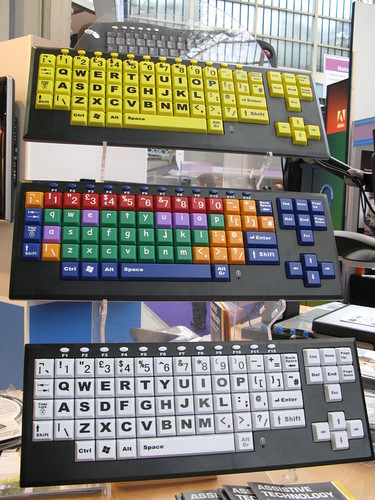
Some nice AT keyboards used with CC permission from Flickr user Rain Rabbit


Thanks for supporting Maine VRC.

Thursday, December 11, 2008

Voice Activated Alarm Clock

voice activated digital alarm clock with blue face
"This unique alarm clock uses advanced speech recognition technology that lets you easily set the time and alarm via voice commands and responds to queries such as What time is it with vocalized answers." -Assistive Technology Services website
Very interesting alarm clock. Why not, the technology exists and allows those with cognitive disabilities as well as visual impairments to use the clock. I suspect though that it's susceptible to problems with accents and speech impediments. See the demonstration below or check it out on their site where there are other interesting AT demonstrations.


Thanks for supporting Maine VRC.

Monday, December 8, 2008

Assistive Tech. as Psychological Marker


Okay, so the title might over state it a bit, but the point is very valid.

"...we can often have the false impression that providing a patient with a bit of kit will be well received as its offers a "solution" to a problem. Sadly however the issue of a device can also be a clear a visible marker of an ability lost or never to be gained and may therefore be received with a distinct feeling of sadness, even anger."

Short but very interesting article. It's imperative that we're cognizant of an individual's feeling about using a piece of AT. For many, especially young people, its others' perceptions of the AT rather than their own. They may understand how it can help them, but the perception may out weigh this. It is not enough to say you should or must, but to help them come to a point of accepting it, and finding a way to build it into their life. This may mean helping them talk to others about what it does for them.


Thanks for supporting Maine VRC.


AT picture used with Creative Commons Permission from Flickr user cobalt123

Wednesday, October 15, 2008

Buying Dragon AT on Ebay

Nice article from Hand to Mouth: Assistive Technology about buying Dragon Natually Speaking 9.5 software from Ebay and what to watch out for. He warns against

“'disk' only” auctions, sold in quantities too large to be believable. You can bet that they’re pirated. The pirated software is a truly bad thing to buy, not only for legal reasons but also functional reasons. One disk means one serial number, a unique way of identifying that particular installation disk."
He says that other warning signs are no box, no paper manual, and not a Dragon headset.

His recommendations would go equally well for any other software I would suspect as well, whether AT software such as Dragon or JAWS, or more general purpose software.

FYI a free version of JAWS is available from the the Freedom Scientific website, it allows you to use it for 40 minutes then locks up, and you have to restart your computer to use it again. Fine for someone like me who uses it for accessibility testing, not great for a regular user. Is a great way to try it out and get some familiarity with it and see if its for you before laying out the $895 for it. http://www.freedomscientific.com/products/fs/jaws-product-page.asp

Thanks for supporting Maine VRC.

Tuesday, September 30, 2008

Fantastic (free) rehabilitation articles from Cornell

Cornell University's ILR school has a free "Digital commons" called the Gladnet Collection with loads of great articles on a range of disability and rehabilitation topics. Below are a few of the ones that jumped out.

Disability and the Muslim Perspective: An Introduction for Rehabilitation and Health Care Providers, Rooshey Hasnain, Laura Cohon Shaikh, and Hasnan Shanawani
Job Accommodations for People with Learning disabilities Dale Susan Brown
Scope of Practice for Rehabilitation Counseling from the CRCC
The Disability Divide: A Study into the Impact of Computing and Internet-related Technologies on People who are Blind or Vision Impaired Scott Emery Hollier, Curtin University of Technology


Thanks for supporting Maine VRC.

Monday, September 8, 2008

"Assistive Technology: A video tour of Accessibility"

A good collection of videos demonstrating various assistive technologies. Demonstrations include screen readers and magnifiers, speech to text software, an AT vendor in the UK's You tube page with various demonstrations of their equipment, and web accessibility.

Word of warning though, the videos I checked were not captioned, and I'm not sure whether any of them are. That aside There's plenty there to browse and learn about assistive technology (AT), so leave some time or return often to wade through the collection.

Thanks for supporting Maine VRC. Please be sure to visit our site at http://MaineVRC.googlepages.com

Tuesday, August 26, 2008

Interview NY Governor David Patterson (by Katie Couric)

Interesting interview with David Patterson, NY Governor


He notes some scary statistics about employment; that 25 percent of those with blindness and 10% of those who have deafness are employed, but yet they exceed the national average educationally. I would have liked to see a little more person first language from him rather than "Deaf girl", but still a good piece that doesn't sentimentalize him or try to make him a "super crip" or inspirational.
I was surprised at his lack of using assistive technology, or technology in general. It seems like he could have so much more information at his fingertips were he to use a screen reader and e-mail. Either way, a good piece about the Governor of New York.


Thanks for supporting Maine VRC. Please be sure to visit our site at http://MaineVRC.googlepages.com

Tuesday, July 29, 2008

$15 coupon for Enable Mart

FYI, there's currently available a $15 coupon for Enable Mart, an AT vendor, via Cubital-Tunnel a site dedicated to Cubital-Tunnel Syndrome. Visit the Cubita-Tunnel site for more information on this repetitive strain injury that can lead to pain in the fingers and arms.

Whether you have Cubital-Tunnel Syndrome or not, given the cost of AT these days, $15 may not go far, but is always welcome.

Friday, July 25, 2008

Digital Wheel Art

Interesting use for the Wii- mote (the controller for the game system Wii), to allow a significantly impaired wheelchair user draw electronically. Basically, the Wii mote works by tracking the movement of the hand held controler in relation to the tv set top box. In this example, one half of the Wii is strapped to the wheel chair and allows the user to move the chair around the floor as though they were painting, while their track is "drawn" on a screen.

There is a short article, and some videos. I have included one below, but it makes more sense once you read the articles and arrangement of technology.

Great use of existing technology. The designer notes that it allows individuals with significant mobility impairments the ability to express themselves artistically.


Digital Wheel Art from Young Hyun Chung on Vimeo.

Wednesday, July 16, 2008

Optimus Maximus Keyboard

Tekzilla has an interesting video on a new keyboard, that has previously only been in theory. The basic premise is that the keys are small computer screens 48 pixles x 48 pixles and allows the user to program each key with a specific image and / or function.
Primarily designed for graphic designers and other tech heavy occupations. This would allow the user to reduce the number of key strokes dramatically, by allowing the user to program the keyboard based on the program they're using. The demo of the keyboard runs from 14:21- 24:16minutes

The top end model, Optimus Maximus is $1800, though other models are available, even down to a 3 button version, called the Mini three, which will set you back $183.

No not specifically Assistive Tech, and quite cost prohibitive, I can see how this technology could in the future allow a user to have a keyboard or other programmable surface customized based on their environment, be that work, shopping, socializing or at home. It's currenty a very cool gadget for the truely devoted (and more wealthy tech lover).

Tuesday, June 3, 2008

Text to speech (in MP3 format)

Techlearning blog has an article on a site that apparently uses text to speech software that allows you to upload a document and it will give it back to you in an audio file that you can download and put on an MP3 player or ipod. Documents can be in a variety of formats including Word, pdf or html.

ReadtheWords.com is a free site and can read English as well as Spanish and french (though you must choose the reader that is "fluent" in that language.) There are 15 computerized voices to choose from. The English voices include US English, UK English and Nina, "US Female/ Indian Accent". At first listen, the voices are amazingly clear, and have a greater variety than the straight speech to text software available. For a list of free versions of text to speech software, visit the MaineVRC site.

This site could be a great tool for users with learning disabilities, allowing them to convert materials to audio versions for use on the fly. Though available in some commercial products, the ability to convert text to audio files for download (or stream from the site) is boosted by the fact that its web based and FREE.

(In the interest of full disclosure, the article does reference the http:\\MaineVRC.googlepages.com site affiliated with this blog, though did not impact the opinions of this author. )

Sunday, May 4, 2008

Student design at Univ. of Illinois

An industrial design class at University of Illinois Urbana-Champaign takes on rehabilitation engineering. Students were required to put their design skills to work to design items for their fellow students, with some positive results. <Link to Article>

I always cringe when I hear about a "disability awareness day" on a college campus or employer which has people use a wheelchair or blindfold to allow people to know what it's like to be disabled. While awareness is great, this approach likely creates more sympathy and "awareness" how difficult it must be for these poor unfortunate disabled people.
I love this project for the prime reason that it gets students to look at how to make the individual more independent, and empowered. It demands that they create solutions, rather than stopping at awareness.

Tuesday, March 18, 2008

Free AT for print disabled from Bookshare.org and Don Jonston partnership

"Bookshare.org and Don Johnston have announced a partnership to provide qualified print disabled students with a free text reader to access electronic books from the Bookshare.org library." <link to article><Press release>

Tuesday, March 11, 2008

Horseradish fire alarm and an Etch-A-Sketch

Here's to thinking "outside the box"- Japanese researchers are testing a smoke alarm that alerts people using the smell of horseradish. Reportedly, those with hearing impairments were "partiularly quick to wake up."

Though it said that all subjects (14) woke within 2 minutes, I don't want to wait that long if there's a fire in my house.
<LINK>

On another note, engineers have rigged up an Etch A Sketch to work with a computer mouse. Sounds fairly complex, but follow the links in the article if you think you'd like to give this project a crack. <LINK>